Radiographs
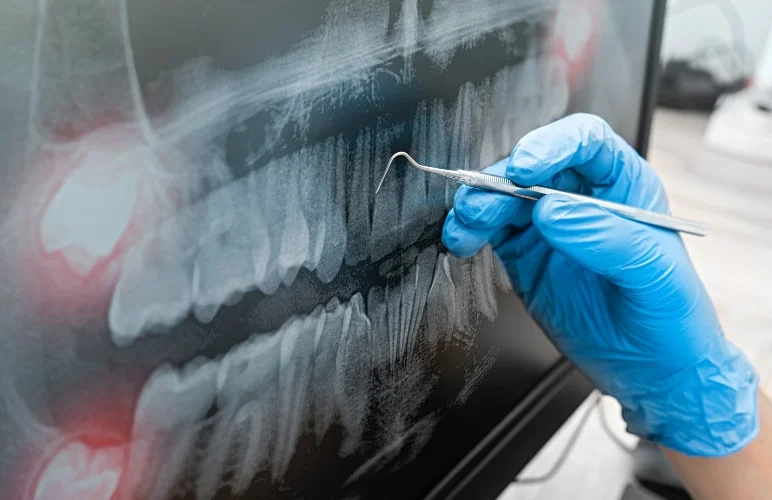
Dentists can only observe problems on the teeth and oral surface with the naked eye, but cannot understand whether there are problems with the internal structure of the teeth or the alveolar bone, such as tooth decay, bone loosening or pulpitis. Therefore, X-ray photography is needed to show the overall oral condition so that the dentist can clearly understand the health status of the patient's teeth and plan a treatment plan.
There are two types of dental X-rays: intraoral X-rays and extra-oral X-rays.
Intraoral X-ray
Intraoral X-rays refer to taking pictures inside the mouth, including the most basic dental X-ray "periapical X-ray", which is used to take pictures of tooth root tips for cavities and lesions, and is responsible for taking pictures of individual teeth; there are also dental X-rays "bitewing" that take pictures of the upper and lower teeth on the same side, which are mainly used to check for easily overlooked cavities between the teeth.
Extraoral X-ray
Extraoral X-rays can comprehensively show the conditions inside the mouth. The X-ray equipment is located outside the mouth. The equipment will rotate around the patient's head in a semicircle, penetrating the mouth with radiation until it surrounds both cheeks. The image simultaneously displays the upper and lower jaw, temporomandibular joint (TMJ), comprehensive teeth, nasal cavity and sinuses, etc. Dentists can obtain multi-faceted information in a single image, which is a complete dental X-ray technology.
Do dental X-rays pose radiation hazards?
We are also exposed to radiation in daily life (such as when basking in the sun or flying on an airplane). If we convert the amount of radiation from dental X-rays, the amount of radiation from an intraoral X-ray is equivalent to one hour of sun exposure at noon; the amount of radiation from an extraoral X-ray is approximately equivalent to 2.5 hours of flying in an airplane. The amount of visible radiation is very low.
Taking X-rays is very safe for both children and adults when equipped with standard protective equipment. We recommend getting a full-mouth and oral X-ray examination once a year to understand your oral health, but if you are concerned about the amount of radiation, you can tell your dentist to consider other examination options.